
Category

Promotions

Cashback or Prize Draw: Choosing the Right Mechanic

Cashback or Prize Draw: Choosing the Right Mechanic

Eighty-nine of the promotions we’re tracking in Australian retail this morning are chance-based — 49 single prize draws, 40 instant wins. Two are cashbacks. That’s out of 137 live campaigns we log across FMCG, liquor, appliances and general retail; the remaining 46 are mostly gift-with-purchase, with a handful of money-back guarantees and collect-to-get mechanics.

It isn’t a reading of what shoppers want. It’s a reading of what a finance team will sign.

Our own cashback forecasts came in at roughly half

Here is the number that should change how you budget, out of the campaign records Trevor Services keeps. On an Electrolux kitchen bundle cashback, the pre-campaign claim estimate was around 1,700. Validated claims landed at 888. On a Westinghouse bundle running much the same structure, the estimate was roughly 2,600 and about 900 people claimed. Two independent campaigns, same category, both landing between a third and a half of forecast.

Be clear about what that does and doesn’t prove. We don’t publish sales denominators for client campaigns, so it isn’t a claim rate — two campaigns isn’t a law of nature either, and part of what it says is simply that the estimate was built optimistically. What it does say, reliably enough to budget on, is that a pre-campaign claim estimate is a ceiling and not a plan. If you’re building a promotional P&L on an appliance-style bundle, budget the full liability, model the likely spend well below it, and decide in advance what you’ll do with the difference.

Most brands book that difference as a saving. We’d argue it’s the most expensive line in the campaign.

An under-claimed cashback isn’t a saving

Some of the gap is people who bought without noticing the offer. Most of it, in our experience of watching claim funnels, is people who noticed, started, and stopped — the receipt photo was too dark, the model number was in the wrong place, the form asked for something they didn’t have to hand. That’s slippage, and slippage is genuinely what makes a cashback cheaper than a straight discount. But the money you didn’t pay out is money that did no work, and someone who abandoned a claim has learnt something about your promotions that shows up the next time you run one.

It’s what we call the Insult Threshold in The Shelf Truth, our promotions playbook: if the reward isn’t worth the effort of claiming it, you haven’t run a promotion, you’ve run a test of your customers’ patience. On a single $4 packet of biscuits, no cashback clears that bar — the claim takes longer than the money is worth, and no amount of form design fixes it. The way around it is aggregation: buy six, get $10 back. That works, but it’s a different promotion with a different job, and it only makes sense if the category is bought in multiples. On a $2,000 appliance bundle, $300 back is worth ten minutes and a photo of a receipt. The mechanic is good or bad relative to the price of the thing, and the appliance category runs on cashbacks for exactly that reason.

What’s the real difference between a cashback and a prize draw?

A cashback pays a fixed amount to every shopper who buys and submits a valid claim, so its total cost depends on how many people claim. A prize draw pays a large prize to a small number of entrants selected at random, so its total cost is fixed the moment the prize pool is set. One is a forecast; the other is a number you can put in a budget line and defend.

That difference, not shopper psychology, is what settles most mechanic debates in Australian planning meetings. Nobody has to justify a forecast that can’t move.

The compliance asymmetry runs the other way

The mechanic finance treats as the safe one is the one that carries a regulatory process.

A prize draw is a game of chance, which puts it in trade promotion lottery territory. In NSW, an authority is required where the total prize value exceeds $10,000, under the NSW Government’s trade promotion rules. In the ACT, a permit is required unless the total prize value stays at or below $3,000, per the ACT Gambling and Racing Commission.

This is less of a timing problem than people assume, and it’s worth knowing why. NSW issues an authority for one, three or five years covering multiple promotions, so a brand that promotes regularly pays the friction once. It’s the first-timer, or the brand whose authority lapsed in a restructure, who discovers the process three weeks out from a national on-pack. What the permit does bite on is change: once the promotion is running, the terms you lodged are the terms you’re stuck with.

A cashback has no element of chance. Everyone who qualifies gets paid, so there’s no lottery and no lottery permit; the obligations are consumer law ones about clear terms and honouring what you advertised. The mechanic with the unpredictable cost carries the lighter regulatory load, and the mechanic finance likes because its cost is fixed is the one with the paperwork. Our guide to Australian competition permits has the state-by-state detail.

If you’re running a draw, run it for a reason

Plenty of products can’t carry a cashback, and for those a chance mechanic is the honest answer. The job then is making the odds feel real rather than making the headline big. Our working rule — the Rule of Three, and it’s a heuristic from running these rather than a measured effect — is that one prize reads as impossible, three read as possible, and a hundred read as probable. A single $100,000 headline against a $6 product looks impressive on-pack and mostly rewards people who were buying anyway. We’ve argued that case at length in prize pool distribution models.

The other thing a draw won’t do for you is data. A prize draw gets you an email address and a stated intent. A receipt-validated cashback gets you the product, the retailer, the date and the price paid — verified purchase data you can plan the next campaign from. If your promotion has a data job attached to it, that difference is the whole decision.

And if the draw exists because you want a headline prize you can’t fund, that’s a financing problem with a financing answer: prize indemnity insurance lets you advertise a prize far larger than your budget for a premium you know up front. Trevor Services sets those up regularly, and it’s a better solution than shrinking the prize until nobody cares.

Pick the failure you can afford

A prize draw fails quietly. Entries come in low, the prize goes to someone who was buying anyway, and the campaign ends with nobody able to say much about what it did. The cost was capped and so was the upside, which is why it rarely gets a post-mortem.

A cashback fails in one of two directions. Everyone claims and you run past forecast — uncomfortable, but it means the offer worked. Or almost nobody claims, the finance report looks excellent, and you’ve quietly taught a slice of your buyers that your promotions aren’t worth their time. The second one costs more and is much harder to see, which is why it keeps happening.

So the position is this. On considered purchases the default prize draw is the wrong call, and it keeps winning the meeting because its cost is legible, not because it works better. If your product can carry a cashback, make the claim easy enough that people finish it, and read a low claim rate as a fault in the design rather than a windfall to bank. Trevor Services builds both kinds every week, and we’re happy to talk through which failure you’re buying.

The prize draw that’s genuinely right for a campaign survives that conversation easily. It’s the one nobody can explain, beyond the fact that the number was easy to sign off, that costs you a quarter.

What Is Slippage in a Cashback Promotion?

What Is Slippage in a Cashback Promotion?

Somewhere in most cashback planning meetings, the offer gets costed at face value. A $100 cashback on a $1,000 appliance goes into the spreadsheet as $100 a unit, the same as a discount would. Anyone who has processed the claims knows that’s not how it plays out — a meaningful share of the people who buy on the promise of a cashback never get around to claiming it. The gap between the two numbers has a name, decades of research behind it, and more influence over a cashback budget than any other single figure. It’s also the number most likely to be missing from the plan.

What is slippage in a cashback promotion?

Slippage is the percentage of eligible buyers who never claim the cashback they’re entitled to. Because unclaimed cashbacks cost the brand nothing, a cashback’s true cost is its face value multiplied by the redemption rate — not the face value itself — which is why a cashback almost always costs less than a discount of the same headline amount.

The industry sometimes calls the same thing “breakage”, borrowing the term from gift cards. Either way, it isn’t a loophole and it isn’t something to engineer. The receipt goes in the bin, the claim window closes, the form gets abandoned halfway — none of it because you designed it that way. Your job is to forecast it accurately, not farm it. And forecasting it is harder than most planning meetings assume, which is the part of this that actually deserves your attention.

The arithmetic: what a cashback actually costs

A discount reaches 100% of buyers, every time, whether they noticed the promotion or not. A cashback reaches only the buyers who claim — and claim rates sit well below what most planners assume. The best public data is a 2023 study by Tremendous and The Decision Lab, which found digital rebates of $20 or less were claimed only around 38% of the time, rising to roughly 50% for $50 rebates. Run that through the spreadsheet: at the study’s observed rate, a $50 cashback costs about $25 a unit in redemptions, where a $50 discount costs the full $50 on every sale. Same headline offer to the shopper, half the redemption cost to the brand.

The academic literature explains why the gap is so persistent. Scott Gilpatric’s Marketing Science paper on slippage in rebate programs ties it to present-biased preferences: the purchase happens now, the claiming effort comes later, and later is where good intentions go to die. The same study data shows claim rates climbing as the money gets bigger — which is why the cashbacks running in the Australian market right now cluster in high-ticket categories: Sony offering up to $1,000 on selected cameras and lenses, LG up to $300 on TVs through Betta, OM System (the old Olympus camera business) up to $500. Nobody runs a $5 cashback on purpose.

How do you forecast a redemption rate?

A redemption rate is a forecast, not a constant, and it moves with five things: the value of the offer relative to the purchase, the friction in the claim process, the length of the claim window, how quickly the money arrives, and who the buyer is. A $15 cashback claimed through a clunky form with a 30-day window and a six-week EFT payout will slip enormously. A $300 appliance cashback claimed by scanning a QR code, uploading a receipt and receiving a PayID payout inside a day will not. Every choice you make about the claim journey moves the rate — which means slippage is partly a design outcome, and you should know which way your design is pushing it before you commit a budget number.

Here’s how wrong the forecasts get, from our own claim queues at Trevor Services. Two recent appliance bundle cashbacks we processed: one was budgeted for roughly 1,700 claims and closed under 900 — 52% of forecast. The other was budgeted for about 2,600 and also closed under 900 — 35% of forecast. Both promotions came in far cheaper than planned, which sounds like good news until you notice that the same forecasting error in the other direction would have blown the accrual by two to three times. If operators with campaign history on hand can miss by that margin, a redemption rate pulled from instinct in a planning meeting isn’t a forecast, it’s a guess with a spreadsheet cell.

Which is why this becomes a finance conversation, not just a marketing one. The redemption forecast sets the liability you accrue, and a promotion that out-redeems its forecast doesn’t fail loudly — it fails in the accruals, months later, when finance asks why claims are still coming in. The honest approach is to budget at a conservative redemption rate, track actual claims weekly against the forecast, and re-accrue as the pattern emerges; the first fortnight of claims data usually tells you where the campaign is heading. For brands that can’t carry the tail risk of over-redemption, sales promotion insurance exists precisely to cap it: you pay a fixed premium and the insurer wears the variance. The brands that get burned by slippage aren’t the ones using it — they’re the ones who never put a researched number on it. And the best predictor of your next claim rate isn’t the planning meeting’s instinct; it’s what similar offers actually did, which is exactly the history worth consulting before you commit the budget line.

The line you can’t cross: slippage and the ACCC

There’s a version of this thinking that tips into misconduct, and it’s worth being blunt about where the line sits. Budgeting for the fact that some people won’t claim is legitimate. Designing the claim process so that people can’t claim — burying conditions, shrinking windows, adding gratuitous steps — is not, and it’s squarely in the regulator’s sights. The ACCC’s guidance on cash back offers is plain: conditions and limitations must be clear to the consumer before purchase, and a business that offers a rebate must intend to honour it as offered. The regulator has been warning brands about undisclosed cashback conditions for years, and a promotion that quietly relies on entrapment rather than forgetfulness is a complaint waiting to be lodged.

The practical test is the one we call the Insult Threshold in The Shelf Truth, our promotional strategy guide: if the effort of claiming isn’t worth the reward, you haven’t saved money, you’ve insulted a customer who did exactly what your advertising asked. High slippage driven by a low-value offer or a hostile claim process isn’t a budget win — it’s a signal the promotion shouldn’t have run in that shape at all. The cashbacks that work are the ones where claiming is easy, payment is fast, and the slippage that remains is the genuine, unforced kind.

Forecast it, don’t farm it

Slippage is the reason a cashback can deliver a $100-off message for materially less than $100 a unit. It’s also the least reliable number in the plan — our own claim queues show forecasts missing by half — which means it deserves the most scrutiny, not the least. Put a researched number on it before launch, design the claim journey deliberately rather than accidentally, track actuals weekly, and stay on the right side of the ACCC’s line. If you’re building a cashback budget and want to pressure-test the redemption assumptions against real campaign history rather than instinct, we’re happy to talk it through. The slippage will take care of itself — it always does. The forecast won’t.

How to Increase Promotion Entries: Cut the Friction

How to Increase Promotion Entries: Cut the Friction

It happens a few times a year at Trevor Services: a promotion launches with a prize genuinely worth wanting, decent retail support behind it, and entry numbers that land well under what anyone hoped. The post-mortem always starts with the prize. It rarely ends there.

More often the problem is sitting in plain sight, in the entry journey. Somebody decided the form needed a phone number and a date of birth. Somebody else added a mandatory account signup because the CRM team asked nicely. Legal added a checkbox, then another. None of those decisions felt expensive at the time. Together, they quietly priced most shoppers out of entering.

What is friction in a promotion?

Friction is everything a shopper has to do between deciding to enter a promotion and actually being entered: finding the entry point, typing a URL, filling in form fields, photographing a receipt, verifying an email, creating an account. In the 3-Second Equation — reward plus belief, divided by friction — it sits in the denominator, which is exactly where you don’t want anything to grow.

The reason friction gets underestimated is that it never appears on a budget line. A bigger prize pool costs visible dollars, so it gets argued about in meetings. An extra form field costs nothing on paper. The cost is paid later, in entries that never arrive, and nobody holds a meeting about those.

Where entries actually leak

Start with when the entry decision happens. Research by Shop! ANZ and Vypr found that 87.6 per cent of grocery purchase decisions are made in-store, and the same study found 90 per cent of shoppers have bought a product purely because it was on promotion. So the promotion is doing its job at the shelf. But the entry almost never happens at the shelf. It happens later, at home, pack on the bench, phone in hand — if the shopper still remembers, and if the journey doesn’t hand them a reason to stop.

That gap between the shelf and the couch is where entries leak, and every extra step widens it. Ecommerce gives us a sobering comparison. The Baymard Institute’s checkout research found that 17 per cent of online shoppers have abandoned a purchase because the checkout was too long or complicated, and that the average checkout displays 23.48 form elements when 12 to 14 would do the job. Those are people who had already decided to buy something they wanted, in exchange for a certain outcome. A promotion entry asks for similar effort in exchange for a chance. If checkout length kills purchases, it isn’t hard to imagine what it does to entries.

In the campaigns we run, the leaks cluster in familiar places. Manual receipt entry is the big one: asking a shopper to key in the store, date, and purchase amount when a photo of the receipt could carry all of it. Mandatory account creation before entry is another, and it is worth noticing that account creation is also one of the top reasons people abandon online checkouts. Then there is the quieter stuff: address fields collected from every entrant when only the winners will ever need them, email verification loops that send shoppers to their inbox and never get them back, and entry URLs printed on packs that were never meant to be typed on a phone.

How do you increase promotion entries?

Cut friction before you raise the prize. Put the entry point on the pack — a QR code that opens a form already half filled in — ask only for what the campaign’s single objective requires, let a photo of the receipt do the data entry, and save the postal address for the people who actually win something. In our experience, the entry journey moves the numbers more reliably than the prize pool does.

The discipline behind this is the One Job Rule. If the promotion’s job is trial, every data-harvest field bolted onto the form is a tax on that job. If the job genuinely is data, then say so, design for it, and accept the smaller entry count that comes with it. What doesn’t work is pretending you can have both for free. Every field has to earn its place against the entries it will cost.

Effort and reward are also the same trade seen from different ends. A generous prize with a tedious journey fails the same way a stingy reward with an easy journey does — the shopper does the maths in a few seconds and walks. We’ve written before about the Insult Threshold, the point where a reward isn’t worth the effort of claiming it. Reducing the effort is often cheaper than raising the reward, and it comes out of nobody’s prize budget.

One honest caveat: not all friction is waste. Purchase validation, entry limits, and fraud controls exist for good reasons, and stripping them out to juice entry numbers is how promotions end up in trouble. The trick is where the work happens. Receipt OCR, velocity checks, and duplicate detection can run server-side, invisible to the honest entrant — this is much of what the Trevor Services platform does. The shopper’s thirty seconds should be spent scanning and snapping, not proving their innocence.

Walk the journey before shoppers do

The cheapest fix is the one made before launch. When we pressure-test a campaign — the process we’ve described as the Kill Sheet — one exercise earns its keep every time: do the entry yourself, on your own phone, starting from the pack. Time it. Count the fields. Count the taps. If it takes longer than a minute, or you feel a flicker of irritation doing it for a product you’d actually buy, you have your answer before spending a dollar on media.

Once the campaign is live, watch where people stop. Entry journeys fail at specific steps, not in general, and a dashboard that shows drop-off by step turns an argument about the prize into a fix for a form. It’s also the kind of pattern that compounds across campaigns — Trudy, our promotional intelligence platform, draws on thousands of past promotions precisely because the same leaks keep appearing in new packaging.

None of this replaces the strategic work upstream: deciding what the promotion is for and where it sits in the wider shopper plan. Bamboo Marketing’s recent piece on shopper marketing strategy for FMCG covers that side of the equation well. But once the strategy is set, the entry journey is where the campaign is won or quietly lost — and it’s the one lever that costs almost nothing to pull.

If your last promotion underperformed and the post-mortem stopped at the prize, it might be worth walking the entry journey with fresh eyes. We’re happy to talk it through.

The Kill Sheet: Pressure-Testing a Promotion Before Launch

The Kill Sheet: Pressure-Testing a Promotion Before Launch

Most promotions that fail were always going to fail. Not because of bad luck or a soft market — because something in the design was broken before the first entry arrived. And the uncomfortable part is how visible those flaws usually are in hindsight: a cashback set just below the effort of claiming it, an entry form asking for ten fields when it needed four, a single hero prize nobody genuinely believed they could win. Everyone in the launch meeting could have spotted the problem. Nobody was asked to look for it.

That’s the job of the Kill Sheet. It comes from The Shelf Truth, the promotional strategy guide we published at Trevor Services, and it exists for one reason: the cheapest time to find out a promotion won’t work is before it launches.

What is the Kill Sheet?

The Kill Sheet is a 15-minute pre-launch diagnostic for promotional campaigns. It tests an idea against the small set of failure points that sink most promotions — a muddled objective, reward maths that don’t work from the shopper’s side, too much entry friction, and unmanaged budget exposure — before any money is committed.

It is deliberately not a creative review. It doesn’t ask whether the idea is clever, on-brand, or likely to win an award. It asks whether the mechanics underneath the idea can actually deliver what the brand needs. A promotion can pass the Kill Sheet and still be dull — that’s a different problem — but a promotion that fails it will not be rescued by better creative. The rest of this article walks through the questions.

Does the promotion have one job?

The first check is the One Job Rule: a promotion should be built to do one thing — drive trial, drive frequency, build baskets, or capture data. Not all four.

This is the check that kills the most ideas, because promotions accumulate objectives the way meetings accumulate attendees. The brief starts as a trial driver, then someone adds a data-capture requirement, then a loyalty element, then a request to lift basket size while we’re at it. Each addition sounds costless. Each one adds a form field, a condition, or a compromise to the prize structure, and the mechanic ends up doing four jobs badly instead of one job well. If you can’t state the single objective in one sentence — and name the metric that will prove it worked — stop there. Fifteen minutes well spent.

Would the shopper do the maths?

The second check is the shopper’s side of the deal, and the framework here is the 3-Second Equation: reward plus belief, divided by friction. A shopper standing at a shelf gives a promotion about three seconds of thought. The reward has to feel worth it, they have to believe they could actually receive it, and the effort of participating has to feel proportionate.

Each part of that equation is a place ideas die. A reward can sit below the Insult Threshold — an amount so small that asking someone to upload a receipt for it does more brand damage than no promotion at all. Belief collapses when the prize structure is one distant jackpot; it recovers when there are enough winners that winning feels possible, which is why how you distribute a prize pool is usually a more important decision than how big it is. And friction compounds quietly: every extra field on an entry form, every additional step between purchase and claim, costs a share of the entries you would otherwise have received. In the campaigns we process at Trevor Services, the promotions that underperform their forecasts are far more often over-complicated than under-funded.

What happens if it works too well — or barely at all?

Budget exposure runs in both directions, and the Kill Sheet asks about both.

If the promotion works better than planned, what is the liability? An uncapped cashback or gift-with-purchase offer scales with every qualifying sale, and a genuinely appealing offer on a high-volume product can redeem well past the forecast. There are established ways to manage this — capping redemptions, structuring the offer, or insuring the promotion so the downside is a known premium rather than an open-ended cost. The failure isn’t having exposure; it’s launching without having decided how much of it you’re carrying.

If it works worse than planned, the question flips: does the budget only make sense at a low redemption rate? Cashback budgets in particular often lean on slippage — the share of eligible buyers who never get around to claiming. Slippage is real and it’s a legitimate part of cashback economics, but a budget that collapses if claiming turns out to be easy is a budget built on hope. Write down the redemption rate the plan assumes, and what happens at double that rate. If the answer is unpresentable, the idea needs restructuring, not optimism.

What are the questions nobody asks until launch week?

The last section of the Kill Sheet is the unglamorous one, and it’s where execution quietly decides the outcome. Does the promotion need a trade promotion permit? In Australia the answer depends on the mechanic and the states involved — games of chance generally need authorisation in NSW, the ACT and South Australia — we’ve covered the state permit rules separately — and permit lead times don’t negotiate with launch dates. Who validates the receipts, and what happens when someone submits the same one twice? Who pays the winners, how fast, and through what channel? None of these are interesting questions in the planning meeting. All of them are very interesting three days after launch.

The same goes for the market you’re launching into. A mechanic that looks fresh in the boardroom may be the fourth of its kind in the category this quarter, and the shopper at the shelf sees all four. It’s worth spending ten minutes checking what’s actually live before committing — our colleagues at Bamboo Marketing wrote a good piece on using competitive intelligence in promotional design that covers how to do this properly. At Trevor we lean on Trudy, our promotional intelligence platform, which tracks a couple of hundred live Australian promotions at any given time — enough to know quickly whether your instant win is a point of difference or wallpaper.

Fifteen minutes, honestly answered

The Kill Sheet only works if the answers are honest, which is harder than it sounds when a room full of people already likes the idea. That’s the real reason to run it as a named, deliberate step rather than trusting that someone will speak up: it gives the sceptic a mandate. One job, named and measurable. Shopper maths that survive three seconds of scrutiny. Budget exposure that’s been decided rather than discovered. Permits, validation and payment answered before launch week. An idea that clears those hurdles has earned its budget.

If you’ve got a promotion on the whiteboard and you want it pressure-tested by people who’ve seen a few hundred of them run, we’re happy to talk it through.

Slippage: Why a Cashback Costs Less Than a Discount

Cashback promotion slippage explained — why a cashback costs Australian brands less than an equivalent discount

There’s a moment in most promotional budget conversations where a cashback and a discount get treated as the same thing. Both are “$100 off”, so both get costed at $100 a unit. Anyone who has run a cashback knows that’s not how it plays out — and the difference runs in the brand’s favour. A meaningful share of the people who buy on the promise of a cashback never get around to claiming it. A discount, by contrast, is applied at the till every single time, whether the shopper even noticed the promotion or not.

That gap has a name, it has decades of research behind it, and it’s the single most important number in a cashback budget. It’s also routinely left out of the planning conversation, which is how brands end up either overpaying for a promotion or — worse — getting a nasty surprise when claims come in higher than the finance team assumed.

What is slippage in a cashback promotion?

Slippage is the percentage of eligible buyers who never claim the cashback they’re entitled to. Because unclaimed cashbacks cost the brand nothing, a cashback’s true cost is its face value multiplied by the redemption rate — not the face value itself — which is why a cashback almost always costs less than a discount of the same headline amount.

In The Shelf Truth we treat slippage as one of the core Budget Hacker levers, and it’s worth being clear-eyed about what it is and isn’t. It isn’t a loophole, and it isn’t something you should be trying to maximise. It’s a behavioural reality: people buy with good intentions, then life happens. The receipt goes in the bin, the claim window closes, the form gets abandoned halfway. Your job as a marketer isn’t to engineer that outcome — it’s to forecast it accurately and budget accordingly.

Why a cashback costs less than a discount of the same size

The arithmetic is simple: a discount reaches 100% of buyers, a cashback reaches only the ones who claim. What surprises most people is how far below 100% claim rates actually sit.

The best public data comes from a 2023 study by Tremendous and The Decision Lab, which found digital rebates of $20 or less were claimed only around 38% of the time, rising to roughly 50% for $50 rebates. Even generous offers leave a substantial share unclaimed. The academic literature backs this up: a Marketing Science paper on slippage in rebate programs ties the effect to present-biased preferences — the purchase happens now, the claiming effort comes later, and later is where good intentions go to die.

In the appliance cashback campaigns Trevor Services runs, we see the same pattern from the other side: actual claim volumes routinely land well under the pre-campaign forecast — sometimes at half of it or less. That’s not a failure of the promotion. It’s what cashbacks do, and it’s precisely why a $200 cashback on a $2,000 appliance can be materially cheaper to fund than a 10% discount — while looking just as generous on the shelf ticket.

There’s a second-order effect worth knowing about too. The same Tremendous study found the payment method changes what the offer is worth in the shopper’s head: mailed cheques and store credit shaved anywhere from $16 to $130 in perceived value off a $300 rebate compared with cash or a prepaid card. Pay people slowly and awkwardly and you’re funding a promotion the shopper mentally discounts before they’ve even bought.

How do you forecast a redemption rate?

You forecast a redemption rate from four inputs: the claim value, the effort required to claim, the length of the claim window, and the payment method — benchmarked against comparable past campaigns rather than gut feel.

Claim value is the strongest driver. The Tremendous data above shows claim rates climbing steadily with the amount at stake, which passes the common-sense test: nobody forgets a $500 cashback on a kitchen bundle the way they forget a $10 one on a kettle. Effort is the counterweight — every extra step between “I bought it” and “I’ve been paid” pushes some claimants out. This is the same mental maths shoppers run at the shelf, which we’ve written about as the 3-Second Equation, just applied at the claim stage instead of the purchase stage. The claim window matters more than most brands assume: a short window increases slippage but also increases complaints, and an overly long one makes the liability hard to close out. And payment method shapes both the claim rate and the perceived value, per the research above — which is why instant payouts via PayID have become the default recommendation on the campaigns Trevor Services delivers, ahead of cheques and slow EFT runs.

This is also where history beats intuition. A brand running its first cashback is guessing; a platform that has processed claims across many campaigns is not. It’s exactly the problem Trevor Services built Trudy for — pulling redemption patterns from thousands of historical promotions to put a defensible number against a new campaign’s forecast, instead of a hopeful one. If you’d rather do it manually, the honest starting point is your own last comparable campaign, adjusted for anything you’ve changed about value, effort, window, or payout. If you have no comparable campaign, assume more slippage at low claim values and less at high ones, and make sure your budget still survives if claims come in well above the forecast. Slippage is a forecast, not a guarantee — the brands that get burnt are the ones who booked the savings before the claims arrived.

Budget for slippage — don’t engineer it

Here’s the uncomfortable part. Once you understand that unclaimed cashbacks are free, there’s an obvious temptation: make claiming harder, and slippage goes up. Long forms, obscure claim portals, receipt requirements designed to trip people up, 14-day windows. It works, in the narrowest sense. It’s also a bad trade.

The shoppers who do fight through a deliberately awful claim process arrive at the payout annoyed, and the ones who give up remember why. We’ve called this the Insult Threshold — the point where the effort of claiming outweighs the reward and the offer starts costing you goodwill instead of buying it. A cashback exists to change purchase behaviour at the shelf; it does that job whether or not every buyer claims. Engineering slippage doesn’t improve the promotion, it just quietly converts a brand-building expense into a source of complaints. Where a cashback sits alongside the rest of the campaign — and what job it’s actually there to do — is a design question worth settling early, and Bamboo’s piece on campaign architecture is a good place to start on that.

The better posture: make claiming as easy as validation allows, pay fast, and let slippage be whatever honest slippage turns out to be. You’ll still come in well under the cost of an equivalent discount, and the people who claim will have had a good experience with your brand at the exact moment you handed them money — which is a rare and valuable combination.

If you’re costing a cashback against a discount and want a realistic redemption number to plan around rather than a guess, we’re happy to talk it through.

Prize Pool Distribution: One Big Prize or Many?

Diagram of prize pool distribution models for structuring promotional prize tiers

Most prize budgets get argued over twice. First when someone decides how much to spend, and again — usually with less rigour — when someone decides how to split it. The second decision is the one that quietly determines whether the promotion works. A brand can commit the same money to a single hero prize or to a hundred smaller ones, and end up with two completely different campaigns. Same budget. Same product. Very different number of people who bother to enter.

This is the part of promotional planning that tends to get settled by taste rather than logic. Someone likes the idea of a car. Someone else wants “lots of winners.” Both instincts can be right, but only for particular jobs. How you distribute a prize pool is a strategic choice, and it deserves the same attention as the budget itself.

What is prize pool distribution?

Prize pool distribution is how a promotion splits its total prize budget across the number, size, and type of prizes on offer — from a single grand prize to many smaller rewards, or a mix of both. It is a distinct decision from how much you spend: the same pool can be structured to feel exclusive and aspirational or frequent and attainable, and that structure shapes how many people enter and who they are.

Put simply, the budget sets the ceiling. The distribution sets the feeling. And the feeling is what the shopper actually responds to at the shelf.

The maths shoppers actually do

People are famously bad at handling probability, but they are bad in a consistent, predictable direction. Behavioural research on the possibility and certainty effects shows that the jump from no chance to a small chance carries far more psychological weight than an equivalent jump higher up the scale. Moving from a 0% chance to a 5% possibility of winning feels bigger and more exciting than moving from 5% to 10%, even though the arithmetic change is identical.

The same body of work on probability weighting shows people systematically overweight small probabilities — a genuine 1% chance tends to feel more like 3 or 4%. That single quirk is doing a lot of the heavy lifting in every prize draw ever run. It is why a promotion with a remote chance of a life-changing prize can still pull entries, and it is why the difference between “impossible” and “just possible” is worth more than any number of extra decimal places on the odds.

The Shelf Truth calls the practical version of this the Rule of Three: one prize reads as impossible, three prizes reads as possible, and a hundred prizes reads as probable. The shopper isn’t calculating odds. They’re asking a much simpler question — does someone like me actually win this? Distribution is how you answer it.

One big prize or many small ones?

Two default models sit at either end. Concentrate the pool into one large headline prize and you buy attention and share-ability — the prize does the marketing, and the story is easy to tell. Spread the same pool across many smaller prizes and you buy belief — more winners, more visible proof, a stronger sense that entering isn’t a waste of time. In the campaigns Trevor Services runs, prize pools tend to fall into one of these two shapes, and the ones that struggle are usually the ones that picked a shape by accident rather than on purpose.

The interesting answer is often neither extreme. The Shelf Truth calls the combination the Dopamine Sandwich: a big prize headline to create the fantasy, wrapped around frequent small wins to make participation feel rewarded. The headline speaks to the part of the shopper that wants to dream about the car. The regular small prizes speak to the part that wants some certainty the effort will pay off. You are, in effect, running two promotions to two different mindsets inside the same budget — which is exactly what a tiered structure is for.

What you should not do is split the difference into mush. A pool sliced into a moderate number of moderate prizes tends to be too small to make headlines and too thin to feel winnable. It satisfies no one in particular. Deciding who the distribution is for — the dreamer or the pragmatist — is more useful than deciding how many prizes sounds nice.

Match the distribution to the one job

Distribution only makes sense once you know what the promotion is actually for. This is where the One Job Rule earns its keep: a promotion built for trial has different needs from one built for frequency or data capture, and each implies a different shape of pool.

If the job is trial — getting new shoppers to pick the product up once — a spread of attainable prizes usually does more work, because visible, believable winning is what nudges a hesitant first-timer. If the job is frequency — getting existing buyers to come back more often — many small, repeatable wins beat one distant jackpot, because the reward needs to show up as often as the behaviour you want. If the job is a headline moment or data capture at scale, a single large prize can be the most efficient way to buy attention and entries. The distribution isn’t right or wrong in isolation. It’s right or wrong for the job.

It also has to survive the shopper’s three-second glance. The 3-Second Equation weighs reward and belief against friction, and distribution feeds the belief side directly. A pool structured so that winning feels plausible does quiet, compounding work every time someone reads the pack — which is also why where the offer lands in the shopper journey matters as much as the prize itself.

Where distribution quietly goes wrong

The most common failure isn’t picking the wrong model — it’s making the small prizes too small. Spreading a pool across many rewards only works if each one clears what The Shelf Truth calls the Insult Threshold: the point below which the prize isn’t worth the effort of claiming it. A five-dollar voucher that takes two minutes of form-filling to redeem doesn’t read as generosity. It reads as a brand that doesn’t value the shopper’s time, and no amount of “500 winners!” copy fixes that. If you’re going to spread the pool, spread it far enough that each win still feels like a win.

The other quiet failure is treating distribution as a set-and-forget decision. A pool that looks balanced on a planning slide can behave very differently once entries start flowing, and the campaigns that perform are usually the ones where someone is watching the shape of participation and can adjust prize cadence or instant-win frequency while there’s still time. That’s the kind of question Trevor Services and its Trudy platform are built to pressure-test before launch — modelling how a given distribution is likely to land against thousands of comparable campaigns, rather than finding out live.

None of this requires a bigger budget. It requires deciding, on purpose, what the prize pool is meant to make the shopper feel, and then splitting the money to match. If you’re rethinking how to structure a prize pool for an upcoming campaign, we’re happy to talk it through.


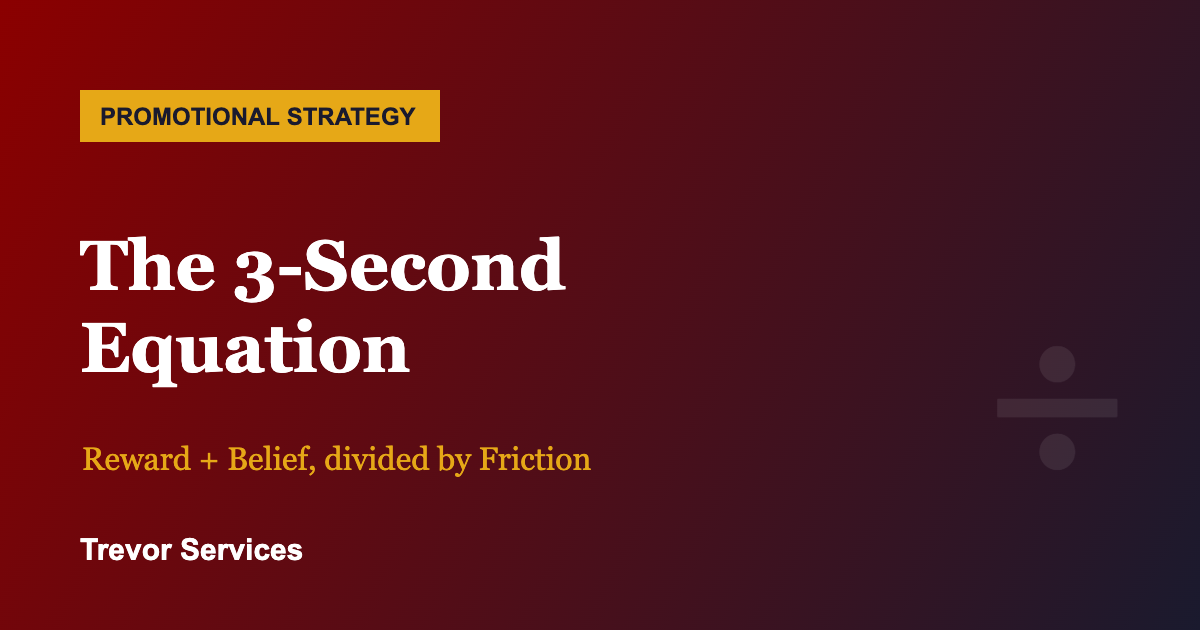
The 3-Second Equation: How Shoppers Judge a Promo

The 3-Second Equation: reward plus belief divided by friction — Trevor Services promotional strategy

Watch someone decide whether to enter a promotion and you’ll miss it if you blink. They see the flash — WIN A CAR, $10 cashback, scan to enter — and within a few seconds they’ve either reached for their phone or moved on. No spreadsheet, no deliberation. Just a fast, mostly unconscious judgement about whether this is worth the bother.

That judgement is the whole game. You can spend months on creative, media and prize budget, and it all gets compressed into the three seconds a shopper spends deciding if your offer is worth their time. At Trevor Services we’ve come to think of that moment as the 3-Second Equation — the shorthand from The Shelf Truth for the sum every shopper runs without realising they’re running it.

What is the 3-Second Equation?

The 3-Second Equation is the quick mental calculation a shopper makes when they see a promotion: Reward plus Belief, divided by Friction. How much do I want the prize? Do I genuinely believe I can win it? And how much effort will entering cost me? If the top of that sum outweighs the bottom, they enter. If it doesn’t, they scroll on — and no amount of media spend buys that decision back.

It’s deliberately crude. The point isn’t precision; it’s that all three terms have to work together. A brilliant prize nobody believes they’ll win fails. A winnable prize nobody wants fails. A genuinely appealing, winnable prize buried behind a ten-field form fails just as quietly. Most promotions that underperform aren’t broken in some exotic way — one of the three terms has quietly collapsed and taken the rest down with it.

Is the reward actually worth wanting?

Reward is the easiest term to get wrong, because it feels like the easiest to get right. Bigger prize, more appeal — except it doesn’t work like that. What matters is whether the reward clears the bar of being worth wanting at all. The Shelf Truth calls that floor the Insult Threshold: if the effort of claiming outweighs what’s on offer, you haven’t given someone a small reward, you’ve given them a small annoyance. A $2 saving that needs a receipt upload and a sign-in isn’t a modest win; it’s a reason to feel faintly insulted.

There’s also a quirk in how people value rewards that’s worth understanding. In a well-known set of experiments, Shampanier, Mazar and Ariely found that when a price drops to zero, demand jumps far more than the maths predicts — people don’t simply subtract cost from benefit, they treat “free” as a category of its own. That’s why a guaranteed gift with purchase can pull harder than a discount of similar value, and why a self-liquidating premium works at all. Reward isn’t only about size. It’s about how the brain files it.

Do people believe they can win?

Belief is the term most brands forget they can influence. A shopper looks at a single major prize and quietly concludes: not me, never me. The odds feel like zero whether they are or not. The Shelf Truth’s Rule of Three is a useful way to think about it — one prize reads as “impossible”, three prizes as “possible”, and a hundred small prizes as “probable”. Same total budget, very different sense of whether it’s worth a go.

That’s really a question of prize architecture: how you split a fixed prize pool to change what people believe about their chances. Our colleagues at Bamboo Marketing wrote about designing a prize structure worth entering, and it’s the other half of this term. The headline prize creates the desire; the spread of smaller, more believable wins is what turns that desire into entries. Of the live Australian promotions Trevor tracks, single-prize draws are comfortably the most common mechanic — which tells you how often brands lean on one big number and hope, rather than engineering belief. The fix is rarely a bigger prize. It’s a better-shaped one.

How do you reduce friction without gutting the entry?

Friction is where good promotions quietly bleed. Every field, every step, every “create an account to continue” is a small tax on entry, and the taxes compound. The instinct is to strip everything back to a single tap — but the evidence here is more interesting than “shorter is always better”. Venture Harbour’s review of form-length studies found cases where cutting fields actually reduced conversions: one optimiser removed fields and saw a 14% drop, because he’d cut the parts people were happy to fill in and left only the dull ones.

The more useful frame comes from BJ Fogg’s behaviour model, where action happens when motivation and ability meet at the right moment. Friction sits on the ability side, and it trades against motivation. A highly motivated entrant will tolerate a receipt upload; a merely curious one won’t tolerate a second screen. So the question isn’t “how few fields can we get away with” — it’s “how much friction have this reward and this belief earned the right to ask for”. A car draw can ask for more than a $5 cashback can, because the top of the equation is bigger. Some friction is also non-negotiable: receipt validation and fraud checks protect the promotion, and the job is to make necessary effort feel proportionate, not to pretend it away.

Working the whole equation, not one term

None of these terms is hard to grasp on its own. The mistake is treating them separately — polishing the prize while ignoring belief, or obsessing over a frictionless form attached to a reward nobody wants. The 3-Second Equation earns its keep because it forces you to hold all three at once, and to be honest about which one is dragging.

It also pairs neatly with the One Job Rule: once you know the single job a promotion is doing — trial, frequency, basket, data — you know which term to weight. A data-capture promotion can carry more friction; a trial promotion can’t afford any. This is the kind of pre-launch pressure-testing Trudy, Trevor’s predictive promotional intelligence platform, is built for — running a mechanic against thousands of past campaigns before a dollar is committed.

So if you’re sketching out a promotion and something feels off but you can’t quite name it, try running it through the equation. Usually one of the three terms has collapsed and you just hadn’t spotted which. If you’d like a hand pressure-testing the idea before it goes live, we’re happy to talk it through.

The Insult Threshold: When a Reward Isn’t Worth Claiming

The Insult Threshold — when a promotional reward isn't worth the effort to claim

Somewhere in a planning meeting right now, a brand team is arguing about whether a cashback should be $5 or $10. The $5 version protects the budget. The $10 version feels generous. What rarely gets said out loud is the question that actually decides whether the promotion works: at what point does the reward become too small for anyone to bother claiming it?

That tipping point has a name. In The Shelf Truth we call it the insult threshold, and it quietly kills more promotions than bad creative ever will. A promotion can be perfectly compliant, beautifully designed, and properly funded, and still fail because the reward on offer wasn’t worth the effort of putting your hand up for it.

What is the insult threshold?

The insult threshold is the point at which a promotional reward is too small to justify the effort of claiming it, so the customer decides it isn’t worth doing. Below that line, a shopper does a quick mental sum — what they get versus what they have to do to get it — and walks away. The offer hasn’t just underperformed; it has mildly annoyed the person it was meant to attract.

This is the same shopper maths behind what we call the 3-Second Equation: reward plus belief, divided by friction. A reward that sits below the insult threshold drags the whole equation down no matter how strong the rest of the campaign is. You can have a believable prize and a famous brand, and still lose people at the point where the number on the offer is too small to move them.

Why small rewards quietly fail

The evidence from rebates is hard to argue with, because rebates make people do real work to collect real money. When the payoff is between $10 and $30, redemption tends to sit in the range of 10 to 30 percent, and falls below 10 percent for smaller dollar amounts. The pattern is consistent: the smaller the reward, the fewer people claim it, even though claiming is the entire point of the exercise.

It isn’t only that people forget. When Leflein Associates asked consumers why they missed out on rebates, 41 percent admitted they simply forgot and 25 percent lost the paperwork, but 20 percent made a deliberate decision that the reward wasn’t worth the effort. That last group is the insult threshold in plain sight. One in five people looked at the offer, did the calculation, and chose not to bother. They weren’t careless. They were rational.

This is also why participation rates are so wide. Consumer Affairs has noted that rebate take-up generally ranges anywhere from 5 percent to 80 percent depending on the value of the rebate. Value is the variable doing most of the work. Get it right and most eligible buyers claim; get it wrong and you’ve printed a discount almost nobody collects.

It’s not the dollar amount on its own — it’s the effort sitting next to it

The insult threshold isn’t a fixed number you can look up. A $5 reward can feel generous on a $15 purchase and insulting on a $1,500 one. The reward is always judged in proportion to two things: the price of what the customer bought, and the effort required to claim.

That second part is where promotions lose people without anyone noticing. Every extra step in a claim — another form field, a receipt photo that has to be retaken, a code typed in from a curling docket — is friction, and friction is a cost paid in lost claims. We call this friction as a cost for a reason: it compounds. A reward that would have cleared the insult threshold with a two-tap claim can fall below it once you bolt on registration, receipt upload, and a survey. You haven’t changed the dollar figure, but you’ve raised the price of collecting it, and the customer’s mental sum tips the other way.

This is the trade-off worth sitting with. Brands often try to protect a reward budget by shrinking the reward, when the cheaper fix is usually shrinking the effort. A slightly smaller prize that’s genuinely easy to claim will often beat a larger one buried behind a clumsy process. In the cashback campaigns Trevor Services has run, the programs that perform are almost always the ones where validation and payout are quick and the customer can see exactly what they’ll get and when.

How much should a promotional reward be worth?

There’s no universal figure, but there is a usable test. A reward clears the insult threshold when it is large enough that a reasonable person, looking at the effort involved, would say “yes, worth it” without hesitating. If you have to talk yourself into it, your customer won’t.

In practice that means sizing the reward against the purchase, not against your budget line. A cashback worth a meaningful share of the item’s price reads as real money. The same dollar amount on a much pricier product reads as a rounding error and gets ignored. It also means being honest about category norms. Australian shoppers are more deal-aware than ever under cost-of-living pressure, and they sit inside a mature cashback ecosystem — Cashrewards, ShopBack and others have trained people on what a serious offer looks like. A brand-direct promotion is being judged against that backdrop, not in isolation.

Prize draws play by a different rule, because there the reward is a chance rather than a certainty. A single enormous prize can still feel out of reach, which is why the Rule of Three matters: one winner reads as “impossible,” a few winners as “possible,” and many small wins as “probable.” The insult threshold there isn’t about the dollar value of one prize but about whether entering feels like it could plausibly pay off. Certainty rewards like cashback are judged on size; chance rewards are judged on believability. Most weak promotions confuse the two.

The thinking behind all of this is what Trudy, Trevor’s predictive promotional intelligence platform, is built to pressure-test — looking across thousands of past promotions to flag when a reward is likely sitting under the line before the campaign goes live, rather than after the redemption numbers come in disappointing.

The test worth running before you launch

Before a promotion goes out, it’s worth doing the customer’s sum yourself. Look at the reward, look honestly at everything you’re asking the customer to do to claim it, and ask whether the first genuinely outweighs the second. If the answer is “only just,” you’re near the line. If you’re trimming the reward to protect the budget, check whether trimming the friction would protect it more cheaply — slippage from forgotten claims already does some of that work for you, and you don’t need to insult anyone to capture it.

The brands that get this right tend not to be the most generous. They’re the ones who understood that a reward is only worth what it’s worth after you subtract the effort of getting it. If you’re rethinking how you size rewards across your promotions, we’d be happy to talk it through.

Self-Liquidating Premiums: When the Gift Pays for Itself

Self-Liquidating Premiums: When the Gift Pays for Itself

Most brands reach for a discount when they want to shift volume, because it’s the lever everyone understands. Knock a few dollars off the shelf price, sales lift, job done. The cost shows up later in the margin line, because a price cut gives away real money on every unit sold — including to the shoppers who would have bought at full price anyway. A self-liquidating premium is one of the few promotional tools that sidesteps that trap, and it stays quietly underused on Australian shelves while prize draws and straight discounts soak up the attention.

What is a self-liquidating premium?

A self-liquidating premium is a gift the customer part-pays for, at or near what it costs the brand to supply, so the promotion funds itself instead of eating into margin. The Monash Business School marketing dictionary describes a self-liquidator as a form of consumer sales promotion in which money and proof of purchase are traded in for an item of merchandise, usually sold below normal retail price.

In practice it works like this. The shopper buys the product, sends in proof of purchase plus a small payment, and receives a premium that feels like a bargain — a branded item worth far more at retail than the few dollars they handed over. The word that does the work is “self-liquidating”: the customer’s payment liquidates the cost of the gift. That’s the difference between this and a standard gift with purchase, where the brand funds the whole thing.

Why it appeals to a budget hacker

The maths is the attraction. The shopper sees the full retail value of the premium and weighs it against a token price. The brand only carries the gap between what it sources the item for and what the customer pays — and source well, in volume, and that gap shrinks close to nothing. It’s one of the cleaner moves in what The Shelf Truth calls the budget hacker’s toolkit: real perceived value handed to the shopper without the brand writing off margin to do it.

There’s a second piece of economics worth being honest about. Not everyone who is eligible actually claims. In any promotion that asks the customer to do something — keep a receipt, go to a site, pay a token amount — a share of people never get around to it. That uplift is part of why a premium can cost less than it looks on paper. But it’s a poor idea to build a plan that leans on people forgetting. The shoppers who do claim are exactly the ones who liked your offer most, and a clumsy experience for them does more brand damage than the saving is worth. Treat slippage as a margin of safety, not the strategy — the same discipline that separates a well-run cashback campaign from a complaint generator.

Set against a discount, the contrast is sharp. A price cut is certain margin loss on every single unit, handed to loyal buyers and bargain hunters alike. A self-liquidating premium only costs the brand when a shopper actively wants the gift enough to pay for it and claim it — and even then, the cost is a fraction of the perceived reward.

When does a self-liquidating premium actually work?

It works when a few things line up, and falls flat when they don’t. The premium has to be genuinely wanted and obviously on-brand. A coffee brand offering a quality plunger, an appliance brand offering a matched accessory — the gift should feel like a natural extension of the purchase, not landfill with a logo on it. Relevance is most of the game.

The token price has to sit below what The Shelf Truth calls the insult threshold — cheap enough that paying feels like a steal rather than a second purchase. If the shopper does the sum and decides they’re really just buying the item at a modest discount, the spell breaks. The payment should feel like a formality that unlocks something good, not a transaction they have to weigh up.

Friction has to be low, because every step between “I want that” and “it’s on its way” sheds claims. A long form, an awkward payment step, a proof-of-purchase requirement that’s a hassle to meet — each one quietly trims the number of people who finish. And the premium should do one job. A self-liquidating premium is usually a basket builder or an affinity play; trying to make it also harvest data and drive first-time trial in the same mechanic tends to dilute all three. That’s the one job rule in action.

Where it goes wrong

The most common failure is forecasting. You’re ordering premium stock against a level of uptake you can’t know precisely in advance. Over-order and the “self-liquidating” promise quietly breaks, because you’re now sitting on unsold inventory you paid for. Under-order and you disappoint the keenest customers and risk a compliance problem, since a promotion that can’t honour valid claims is a promotion in trouble. Getting that order quantity roughly right is the difference between a tidy campaign and an expensive one, and it’s exactly the kind of decision Trudy, Trevor’s promotional intelligence platform, is built to pressure-test against real campaign history rather than a hopeful guess.

Quality is the next trap. A premium that feels cheap in the hand does more harm than offering nothing at all, because now the brand association is “disappointing.” Then there’s the part nobody photographs for the pitch deck: someone has to validate proof of purchase, take the token payment cleanly, dispatch the premiums, and sort out the ones that go missing in the post. That fulfilment layer is where a promotion is actually remembered fondly or not. And a self-liquidating premium is not a rescue for a category that only moves on price — if the shelf only responds to a cheaper number, a gift won’t carry it, and a different mechanic or an honest look at alternatives to discounting is the better conversation.

The part that’s easy to underestimate

On a slide, a self-liquidating premium is simple: the customer pays for the gift, the brand looks generous, everyone wins. In delivery it’s a chain of small operational decisions — validating receipts or unique codes, taking payment compliantly, holding and dispatching stock, handling the exceptions — and the campaign is won or lost in that chain, not on the slide. Trevor Services runs that machinery for Australian brands across grocery, liquor and appliances, which is why the question we ask first isn’t “what’s the gift?” but “at what token price, and what uptake, does this actually pay for itself?”

If you’re weighing a premium against another round of discounting, it’s worth running the numbers properly before you commit the stock. We’re happy to talk it through.

The One Job Rule: Why a Promotion Should Do One Thing

The One Job Rule promotional strategy header — Trevor Services

Look at most promotional briefs and you will find a wishlist. The campaign is meant to drive trial, reward loyal buyers, lift basket size, collect first-party data and make the brand feel a bit more fun — all from one mechanic, one prize pool and one eight-week window. It reads like ambition. It usually behaves like confusion.

The promotions that actually move a number tend to be the ones that picked a single job and built everything around it. That discipline has a name in The Shelf Truth — the One Job Rule — and it is the cheapest thing in promotional marketing, because it costs nothing and saves you from spending budget in five directions at once.

What is the One Job Rule?

The One Job Rule says a promotion should be designed to do one thing well, and judged on whether it did that one thing. You pick the objective first, then choose the mechanic, the prize and the level of friction to serve it. Anything that does not serve the one job is either neutral or quietly working against it.

There are really only five jobs a promotion can do, and they pull in different directions. A Breaker is built for trial — getting someone who has never bought the product to try it once. A Builder is for frequency — getting an existing buyer to come back sooner. A Loader is for basket size — getting a bigger shop in a single visit. A Harvest is for data — trading a reward for permission to keep talking to the customer. And a Keeper is for loyalty — giving regular buyers a reason to stay. The reason you cannot do all five at once is that each one wants a different shopper to do a different thing, and a single offer cannot send five signals without blurring all of them.

Trial is the clearest example. If the job is to break a non-buyer into the category, the entry barrier has to be almost nothing, because you are asking a stranger to take a punt. The moment you bolt on a data-capture form or a minimum-spend threshold to also serve the Harvest or the Loader, you have made the Breaker worse. The person you most wanted — the curious first-timer — is the one who drops out first.

Pick the job before you pick the mechanic

The most common mistake is choosing the mechanic first. Someone in the room wants an instant win because it sounds exciting, or a prize draw because the last one ran smoothly, and the objective gets reverse-engineered to fit. You can see the gravity of this in the live market: of the roughly 170 Australian promotions Trevor Services is tracking at the moment, the single-entry prize draw is by far the most common mechanic, well ahead of gift-with-purchase and instant win. Prize draws are popular partly because they are genuinely flexible and partly because they are the safe default — the thing you reach for when nobody has decided what the promotion is actually for.

Across the campaigns Trevor Services has run, the spread looks similar — simple-entry draws and sweepstakes make up the bulk, with gift-with-purchase and cashback behind them. None of those mechanics is right or wrong on its own. A prize draw is a fine Harvest and a poor Builder, because a one-in-a-million draw gives a regular buyer no reason to come back sooner. A cashback is a strong Loader or Builder and a weak Breaker, because the reward only lands after the purchase the non-buyer has not made yet. The mechanic is not the strategy. The job is the strategy, and the mechanic is how you pay for it.

Once the job is settled, the friction question answers itself. If the job is data, you have earned the right to ask for more, because the reward is meant to be a fair trade for information. If the job is trial, every extra field on the form is a tax on the exact behaviour you are paying to create — a rough rule we use is that each additional field quietly costs you a slice of your entries, and the drop-off compounds. This is where a tool like Trudy, Trevor’s predictive promotional intelligence, earns its keep: it can look at thousands of past promotions and flag when the friction you have designed is out of step with the job you said you wanted.

What is the insult threshold in a promotion?

The insult threshold is the point where the reward is not worth the effort it takes to claim it. Ask someone to keep a receipt, scan a QR code, fill in a form and wait three weeks for a two-dollar cashback, and you have not run a promotion — you have run a test of their patience. Cross the threshold and entries do not just fall; the brand wears a small grudge that outlasts the campaign.

The threshold is not a fixed number, which is what makes it easy to trip over. It moves with the effort you are asking for. A low-effort entry can carry a modest reward and still feel fair. A high-effort claim — proof of purchase, multiple steps, a delay before payout — needs a reward big enough to justify the work, or the whole thing reads as mean. The trap is designing the effort and the reward separately: the operations team adds verification steps to control fraud, the finance team trims the prize to protect margin, and nobody notices that the two decisions, made in different meetings, have together pushed the offer over the line.

This is also where the One Job Rule and the insult threshold meet. If you have decided the job is data, you are by definition raising the effort, so the reward has to rise with it. A promotion that asks a lot and gives a little is not a frugal promotion. It is a promotion that will underperform and then get blamed on the category, the weather or the media plan — anything except the offer.

How do you test for this before launch?

You do not need a model to catch most of these problems — you need fifteen minutes and an honest answer to a few questions. The Shelf Truth calls it the Kill Sheet, and the first question is always the same: what is the one job? If three people in the room give three different answers, the promotion is not ready, and no prize budget will fix that. The next questions are whether the mechanic actually serves that job, and whether the reward clears the effort you are asking for.

Timing matters too. With the end of financial year landing in late June, a lot of Australian brands are about to push promotions into the busiest value-seeking window of the year. That is exactly when the temptation to make one campaign do everything is strongest, because the stakes feel higher. It is also when the discipline pays off most, because a crowded market rewards the offer that is clear about what it is for. Whatever mechanic you land on, it still has to be compliant — a game of chance can need a permit in New South Wales, the ACT, South Australia and the Northern Territory, and the rules are worth checking against the relevant state regulator and the Australian Consumer Law before anything goes live.

None of this is about doing less for the sake of it. It is about spending the same budget on one job done properly instead of five jobs done halfway. If you are pressure-testing a promotion before it launches and want a second read on whether the mechanic and the reward match the job, we are happy to talk it through.

Book your free demo

Quick details so we can prep for your call.

Skip — go straight to Calendly